
Introduction to the PAC model in TA

As a coach, I am deeply listening to the words my clients use so that I can get a sense as to how they’re seeing the world and to tune into any possible limiting beliefs that might be behind their words that they’re using and holding them back. In the 1950/60s, Eric Byrne developed the theory of Transactional Analysis to help us understand why we feel, think and act the way that we do.
Frequently in coaching, clients are bringing to the session issues or challenges in their relationships with other people. This may be in the form of feelings and emotions in response to interactions they’ve had, and one of the ways that we, as coaches, can support our clients is to help them unravel their experience and understand what’s going on so that they can be more choiceful in how they act.
Using the PAC model in Coaching
A model that I like to share with my clients is called the PAC model, which helps us understand the transactions (interactions) that we have with other human beings. The central idea is each of us has three ego states:
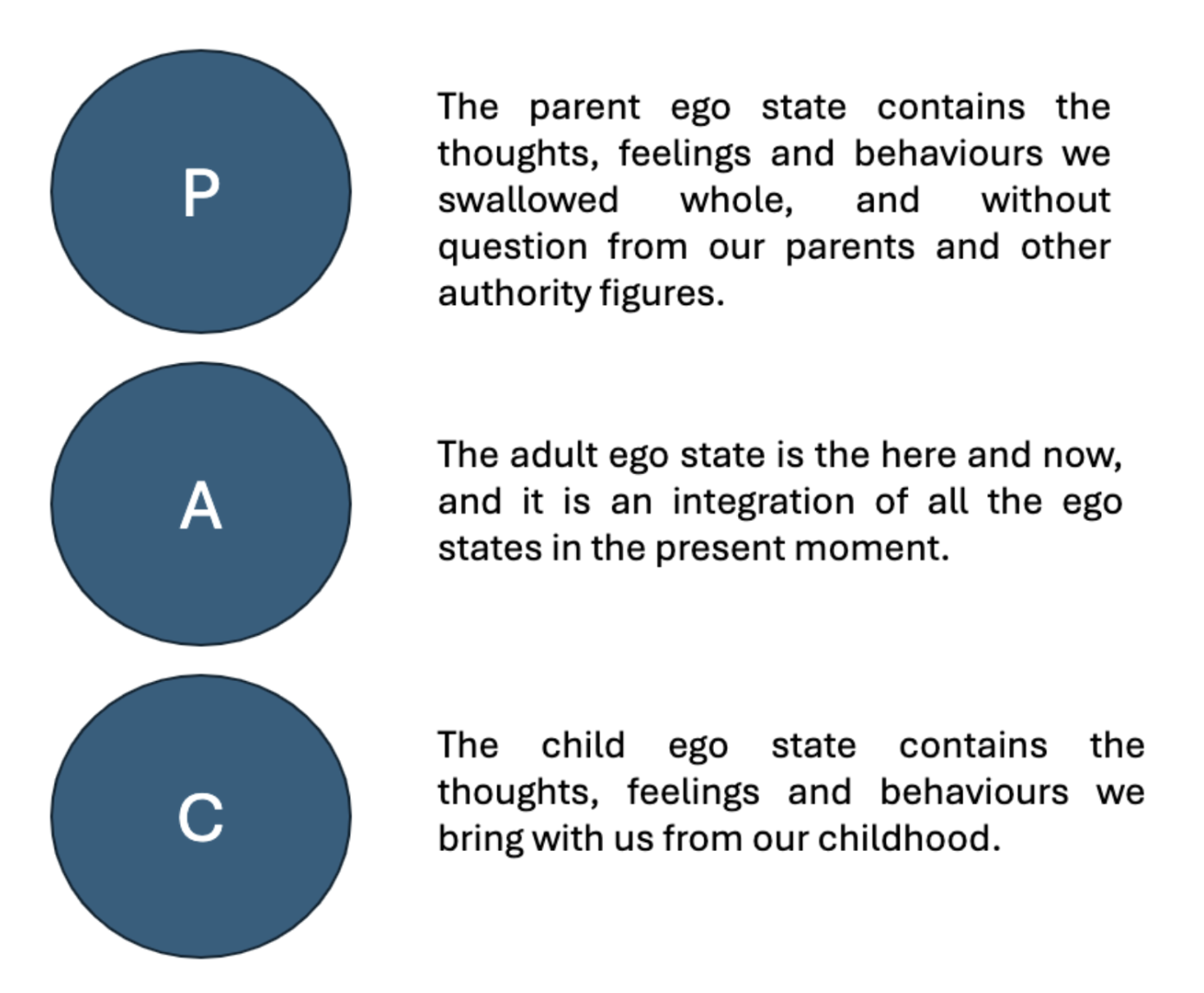
These ego states can show up in different ways. The Parent ego state can be nurturing or controlling. The child ego state can be the free child, or the adapted child who adapted to whatever the world was like back then (either compliant or rebellious).
This can be a useful lens as a coach because if a client talks about themselves using critical language, I may be curious about their internal dialogue. In other words, how do they speak to themselves day to day, and where did they learn this behaviour? It may transpire that one of both of their parents were particularly controlling or critical during their childhood, and as a result the client has absorbed this critical voice into their Parent ego state.
TA can also help clients to understand why they behave the way they do. TA is full of visual diagrams, so for a client who learns visually, sharing the PAC model with the client can be a powerful tool. We can tune into our experience of our clients too, to help us support them in deepening their self-awareness.
An example
One client that I worked with was expressing frustration with why they couldn’t move forward with a piece of work. They described themselves as procrastinating, and seemed stuck, almost powerless as to how to move forward.
Sharing my observation of them in this way and being curious about how familiar this was to them revealed that when they were young, they learned that they had to “get it right” and “please my parents”.
Using the PAC model to highlight that these beliefs may reside within their Child and Parent ego states allows the client to acknowledge that this is a historical behavioural tendency and one, which may not be as useful in the here and now, as it was back then. It is at this point that we can support clients to take a breath, and intentionally choose to act from their Adult ego state.
Interactions = Transactions
Eric Berne used the PAC model to help illustrate how people can communicate between each other – he called these transactions. At any one time, an individual will be communicating from one of his or her ego states. Communication is smooth and straightforward when the activated ego states are complimentary. For example, Adult to Adult.
Where communication evokes a response that is surprising or not expected, the activated ego states are usually crossed. Here, the response to the stimulus is from an ego state other than the one that has been invited, resulting in an element of surprise. For example:
(Stimulus) What time is it? (Adult)
(Response) You are always late anyway, why do you care? (Critical Parent)

In an ulterior transaction, two messages are conveyed at the same time; the words we say and the psychological message underneath. In other words, what is said is not necessarily what is meant. Berne suggested that when this happens, the psychological message will determine the outcome. On the surface, the transaction may appear to be smooth, but the psychological message is communicated via voice tones and facial expressions. For example:
(Stimulus) Where did you put my car keys? [Psychological message: You are always moving my things!]
(Response) In the drawer, where I always put them! [Psychological message: You are always criticizing me!]
Being attuned to our client, deeply listening to what they are saying and noticing the impact this has on us can be hugely powerful. Shining a light onto learned behaviours and limiting beliefs supports behavioural change and leads to new insights that may otherwise have remained hidden.
As you can see, the beauty of TA is the insights that a visual model such as PAC can bring to a coaching session. There is much more to TA than the PAC model. Check out our podcast series on the topic and our series of blog posts. If you’d like to find out more, please get in touch.
LISTEN NOW


© 2020 Copyright Bloom People – design by Smith – development by Thames Web Design
[/et_pb_text][/et_pb_column][/et_pb_row][/et_pb_section]